
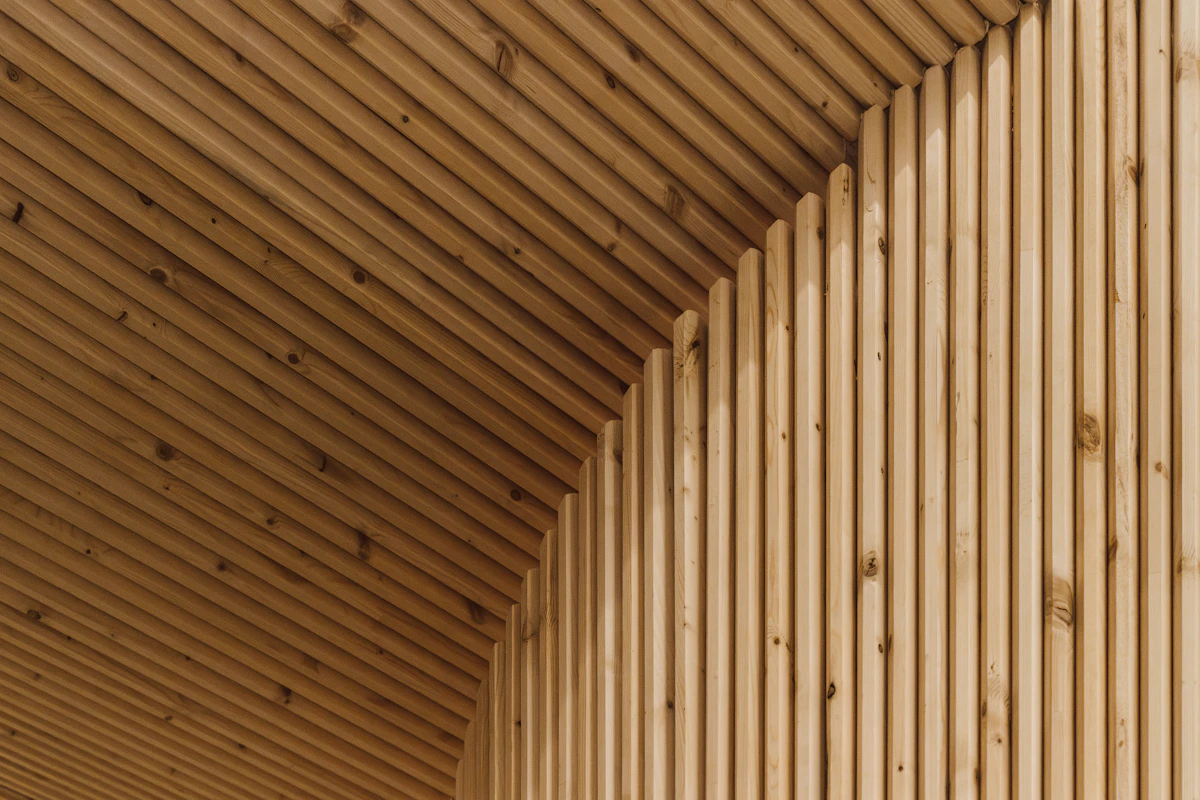
For the first time in the Mass Timber Conference's ten-year history, a curved dowel-laminated timber structure stood on the exhibit floor. Designed in collaboration with our long-time partners, Lake Flato Architects, the pavilion comprises three self-supporting curved DLT panels spanning roughly 30 feet, fabricated flat and bent into shape on site at the Oregon Convention Center.

An Idea Was Born
The partnership with Lake Flato goes back a decade to a cold call about Hotel Magdalena in Austin, Texas. Since then we've delivered five projects together (Museum of Fine Arts Houston, The Soto, One Bridgeland Green, and still-in-design Harold Simmons Park). Our two teams came together to design and build a never-before-built curved dowel-laminated structure. Only made possible by the trust and mutual vision established over ten years of working alongside Lake Flato.

When StructureCraft began planning for IMTC with Lake Flato, we established one rule: Don't just build a box! Push innovation in design and material use. What if curved geometry was easy and simple? Lake Flato ran an internal design competition across their studios, and through many iterations with our engineers, the final concept came down to the 'simple' shape you see here - something of a drooped canvas of timber.
The key structural principal was that the panels get their rigidity from curvature, not depth or mass. Timber performing as a shell, not a beam. Shell construction has belonged to concrete and steel for over a century, and this would be a first of its kind worldwide.

Fabrication and Build
StructureCraft kicked off R&D in January in our Abbotsford shop, which included a test fit of a scaled-down version of the booth. The door was the most difficult part of the process: a section of curved wall panel that peels away and hinges open on its own dowels. The final prototype achieved a 2ft radius, and the computational model matched within half an inch. Panels were then run through our custom CNC to create the etched logos and branding for the external walls.

The door was the most difficult part of the process. A section of curved wall panel that peels away and hinges open, born from a single sketch by Lucas Epp. The final prototype achieved a two-foot radius, and the computational model matched within half an inch. Panels were then run through our standard CNC line to create the etched logos and branding for the external walls.

The panels were flat-packed onto a truck and shipped to the Oregon Convention Center to be erected.
Premiering the Booth
The pavilion was assembled in two days by a StructureCraft crew on the show floor before the conference opening reception on March 31st. Flat panels were lifted, draped into position, and the curve locked in place in real time.

The living door stole the show. Visitors pulled it open, felt the flex and spring of the DLT, and watched solid timber swing like fabric. One of the most surreal moments was a visit from celebrated Japanese architect Kengo Kuma, who stopped by and was photographed smiling and interacting with the bendable door alongside Lake Flato's Ryan Yaden. Speaking about the pavilion, Yaden shared, I think there's something very seductive about the way these forms come together, in the physics of structure, that people naturally gravitate towards. It's a balance of practicality and surprise that makes people want to engage more meaningfully.

Dezeen then ran a feature on the pavilion while we were still at the conference, describing how it challenges the rectilinear logic of mass timber construction. Conversations at the booth and our annual social mixer all pointed to the same thing: people are ready for timber to move beyond rectangles.
What's Next For Curved Timber?
We are already working with a client to apply the principles from this pavilion to two real projects. The structure will also be featured at AIA’s national Conference on Architecture in San Diego next month. As Lucas put it: What we do in the next few years is going to help shape how the whole industry designs with wood.


